13
Argumentation and
Manipulation
Part - 1

We have set our faces
against all shameful secret practices, we use no clever tricks, no
dishonest manipulations of the Word of God. We speak the plain truth and
so commend ourselves to every man’s conscience in the sight of God.—
2
Corinthians 4:2, Phillips Modern
English.
1.
Did you feel intimidated when following JWs?
Even in view of all the evidence presented, I feel it would be
a mistake to think that every one of Jehovah’s Witnesses believes
what he or she believes, and does what he or she does, entirely out of a
conscious or subconscious sense of intimidation by authority. It would
also be a mistake to think that all Witnesses seek to conform to the
organization’s programs of meetings and activity and to its standards of
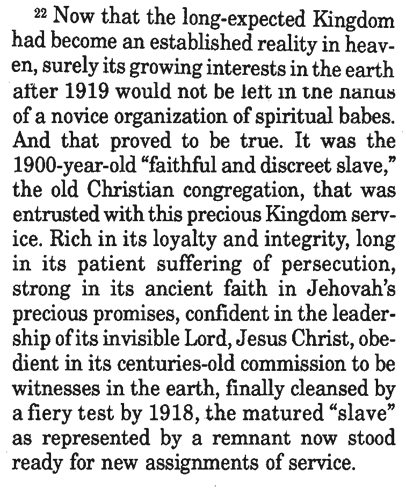
conduct and rules solely out of concern over peer pressure or threat of
sanctions. That may be true of many, but not all.
Actually, any
conscious sense of
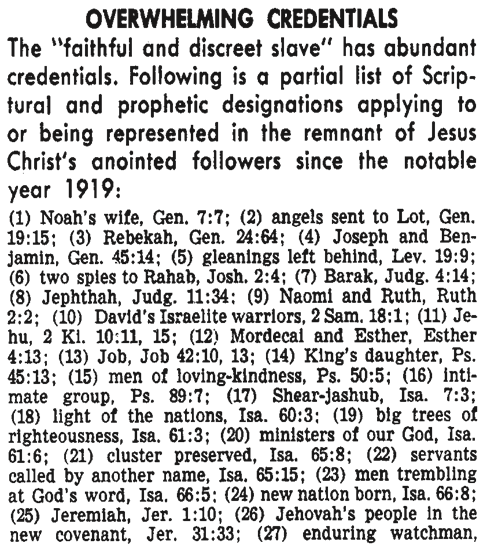
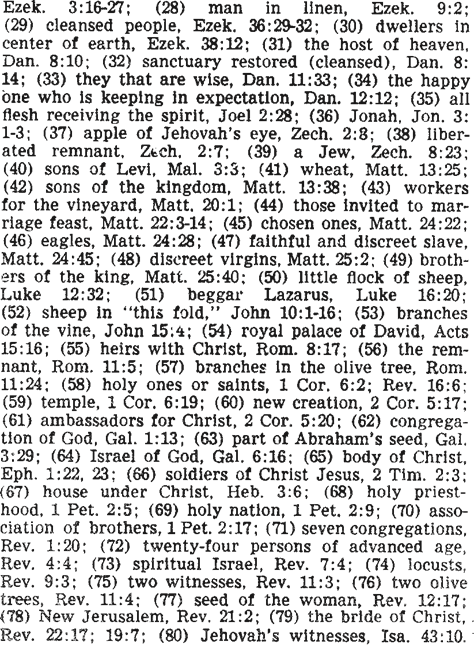
intimidation is often first realized when one begins to raise questions.
Men in authority do not feel threatened by people who comply, but may
feel so toward those who begin asking for reasons why. So while
intellectual intimidation is clearly a strong factor, it is not
necessarily the controlling factor with each individual. I am satisfied
that there are numerous men and women who are where they are simply
because they believe it is “the truth.” I believe that was the
overriding factor in my spending most of my adult life as a full-time
representative of the Witness organization. I did what I did, and did it
wholeheartedly, because I believed I had the truth, God’s truth, and I
am sure the same can be said for many others.
2.
Most JW are intelligent.
Why aren’t more questions asked?
Since there are certainly many clear-thinking, intelligent
persons within the organization, how is it that more questions are not
raised? Undoubtedly here the intimidation factor does have some effect,
and there is definitely a climate of fear existing today as to
expressing doubts. But even if these are not expressed
vocally, why do not more
persons ask questions within
themselves, in their own hearts and minds? In view of the evidence
available, it may seem hard to believe that persons can so readily
accept as “revealed truth” the teachings of an organization with such a
checkered record of reliability. While it is true that as Witnesses we
were trained to discipline ourselves to accept without doubting, I think
that this alone would not have sufficed for us to go along year by year
in a course of almost total acceptance.
I do not consider myself a particularly
gullible person. Although my parents were of this faith, it was not a
case of my following dutifully in their path. In reality, on reaching
the teenage years, I came to the point where I had stopped attending
meetings completely. Then, in 1938, when I was sixteen, my father spoke
to me very seriously about my lack of spirituality, my irreligious
course, and asked me ‘why I thought Jehovah would spare me at Armageddon
when I was doing less than our churchgoing neighbors?’
3. Was fear of Armageddon a motivating factor?
While I recognize that the thought of
facing possible destruction by God for not being fully “in the truth”
had some motivating effect, I know that this likewise was not the sole,
or major, motivation. (I was probably more shaken by the fact that my
own father viewed me as perhaps unworthy of God’s favor and life than by
the thought of any impending future destruction.) Simply put, after
renewing my attendance at meetings I became convinced that what I was
learning through the publications was the truth. Admittedly, the
association with the congregation filled somewhat of a vacuum that had
existed in my life, and the activity I began to engage in gave a sense
of direction to my life. These things without question exerted an
influence. Yet the fact is that I
did believe it. The way in which the material was presented, the
argumentation used, caused me to believe I was learning “the truth.”1
Today I ask myself, “How? Why?” That the argumentation was and is
seriously flawed is clear to me. I do not feel any sense of credit for
now discerning that.
1
This does
not mean that I was fully convinced of all details, but what I did not
see I took on faith.
2
I have in my
library copies of a number of very old Watch Tower publications once
owned by Percy Harding (referred to in Chapter 11). Many of them contain
personal notes in which he shows that he discerned serious flaws in the
reasoning and arguments presented—many decades before I began to arrive
at that realization.
4.
Why are millions of sincere JWs so convinced they have the truth?
The evidence was there all along. So there is certainly no cause
for pride when considering that it took me nearly forty years of my life
to come to the realization of the error. The effect is decidedly more
one of humiliation than exaltation. Others saw many of these flaws
considerably before I did, simply through their study of Scripture.2
They did not have the benefit of nine years of experience in the
inner council of the organization, as I did. How then was I so convinced
for so long? And how are millions of others, many of them clearly
sensible, intelligent persons, similarly convinced?
Unless we are considerably more
credulous than I think is the case, it seems evident that the
argumentation employed is the product of considerable ability—an ability
to present views in a quite plausible, seemingly rational way. Coupled
with that, and perhaps the key to the whole matter, has been the
desire to believe,
wanting to believe.
5.
How does the Society give one a sense of security?
It is normal for people to wish for
certainty and the sense of security that certainty brings. The Watch
Tower organization offers that, for whatever it says it presents as the
right explanation of God’s Word, the
only true explanation, with
no equivocation. It is normal for people to wish there were some source
that could answer all their questions about God, his purposes, about
life and human destiny. The organization offers to do that too, and to
do it with confidence. It is normal to wish to know specifically
what one should do to gain
God’s approval and how and
when to do what He wants. The
organization offers a very clearly outlined program of activity, with
very definite rules of conduct, and the assurance that anyone holding
loyally and submissively to these will be spiritually strong, joyful and
win God’s blessing. It does all this in a way that conveys a sense of
intellectual appeal as opposed to emotionalism, the emotionalism that is
found in many churches and religious revivals.
6.
What does it mean to be in “the Truth?”
To believe that you are “in the Truth,”
that you are part of the one organization on earth that God is dealing
with, a people of divine destiny, the only people on earth who really
understand the Bible, brings for many the sense of security they seek.
That was the feeling I had and it caused me to give myself without
hesitancy to whole souled service under the direction of the Witness
leadership. I was an active part of a growing organization and I equated
the organization’s expansion with the spread of truth, life-giving
truth. To work for the organization’s expansion was to share in the
battle against error, with the conquering power of truth bringing
liberation to those held captive by religious falsehood.
It is a shaking experience to realize
that this is not actually the case after so long a time, when you find
yourself facing the seventh decade of your life. Yet others have
realized it even later in life. In March, 1982, after the appearance of
an article in Time magazine,
a letter from a Witness came, addressed to Peter Gregerson, on whose
property I was then living. It included these comments:
I am writing to you hoping it will come
to the attention of Brother Raymond Franz. I was deeply moved after
reading the article in Time and his letter of appreciation later, which
moved me to think we had something in common.3
I was baptized in 1917 and was at Cedar
Point in 1919 and 1922 and after this was preaching “Millions Now Living
Will Never Die” all around Ohio. I am conscious of the fact that we all
had a sort of built in fear thru the years that we should not question
the Watch Tower. Lately it has come to pass that it’s impossible to
consider scripture in the
Watchtower study and express an opinion without feeling you might be
thrown out of the synagogue as an apostate.
7.
Why did John Knight stay in the Truth?
The person writing, John Knight, was 93
years old. His association with the Watch Tower organization covered a
span of over 75 years. As he wrote later, when seeing inconsistencies
his initial reaction was to blame himself, asking himself if he were not
just a “fault finder.” He was disturbed by one of the same things that
disturbed me: the dogmatism found in the Society’s publications. He
wrote:
Like the Bereans I felt we should search
the Scriptures to see if the things taught us are so. This has troubled
me to no end as thru the years the position of the Watch Tower has been
a total position. I hate to use the word infallible, but that is the
view that many of the friends have, and indeed that is the position I
found myself in, obliged to obey the Society’s mandate. Now came the
hard part when I could not find scriptures to support certain positions
taken by the Watch Tower.4
John Knight’s comments were typical of
many received from persons in various countries—England, Sweden,
Belgium, Germany, Spain, Brazil, Nigeria, New Zealand and other
lands—many of those writing having a background of twenty, thirty, forty
or more years as Witnesses. Remarkably, most of them had arrived at
similar conclusions, privately, with no knowledge that others felt as
they did.
Since truth is inseparably linked with
freedom, it seems crucial that we make it our determination to analyze
what we are told, what we read and hear, and weigh carefully the
factualness of the things stated, and the validity of the argumentation
used. Otherwise we may free ourselves of certain chains of error only to
allow new chains of error to be fastened upon us. Recognizing particular
methods of deceptive argumentation can help us in protecting our freedom
of mind, heart and conscience.
3
The article
appeared in the February 22, 1982 issue of
Time and dealt primarily with
my being excommunicated.
4
My wife and
I visited and had personal conversation with John Knight on more than
one occasion and he maintained communication right up until his death at
the age of 96 (in accord with his request I conducted his funeral).
Recognizing Common Pitfalls of False Argumentation
Brothers, stop
thinking like children. In regard to evil be infants, but in your
thinking be adults.—1
Corinthians 14:20, New
International Version.
We must not be babies
any longer, blown about and swung around by every wind of doctrine
through the trickery of men with their ingenuity in inventing error.—Ephesians
4:14, An American Translation.
8.
What are some of the dishonest methods of argumentation that the
Society Uses?
There are honest and dishonest methods
of argumentation, principled and unprincipled, genuine and artificial.
We have already considered some of these, including the making of mere
assertions, one-sided presentations (where contrary evidence is
suppressed or ignored), use of ridicule toward those taking a contrary
view, “pontificating” on the basis of claimed superior wisdom or
superior authority. These are a few of the invalid methods used. Others
include:
•Misrepresentation of opposing
arguments, as by the use of a “straw man” in the place of the real point
at issue.
•Use of “circular reasoning,” in
which an unproved premise is used as the starting point of an argument
that proceeds to build on the premise rather than on established fact.
•False analogy, where
similarities exist but not the kind needed to prove the conclusions
argued for.
•Creation of a “false dilemma,”
which makes it appear that there are only two choices, the one being
argued for and another that is usually undesirable—when in fact there
may be several choices, several alternatives.
•The dragging of a “red herring”
over the trail of the argument, that is, bringing in some point that is
not relevant to the discussion and which only serves to divert the
reader’s attention from the weaknesses in the argument.
•Ad
hominem (meaning “to the
man”) argument, which consists of an attack on the person argued
against, instead of on his argument.
•Provincialism, that is,
appealing to the tendency to identify closely with the thinking,
belief—even the prejudices, bias or ignorance—of a particular group, and
to see things largely from the standpoint of the in-group versus the
out-group. (In Logic
and Contemporary Rhetoric, pages 54, 55, Howard Kahane of Bernard
Baruch College states: “Provincialism often results in a false
conception of the importance and moral quality of one’s own group . . .
In its extreme form, the fallacy of provincialism turns into a worse
vice, the fallacy of
loyalty. This is the
fallacy of believing (or disbelieving) in the face of great contrary
evidence because of
provincial loyalty.”)
•Misuse of deductive reasoning,
either taking a broad principle and drawing unwarranted or unproved
conclusions from it or, vice versa, using certain incidental facts and
building on these to establish a broad principle that does not
necessarily follow, hence, a hasty “generalization.”
These kinds of argumentation often
overlap or coalesce, the “red herring” may include an appeal to a
“provincial” bias or consist of an
ad hominem attack. But,
however employed, the use of these various forms of argumentation can
frequently produce material that appears very plausible, sometimes even
impressive. And yet it is false.
9.
What feeling may some of the Society’s “false intricate and
winding reasoning” produce in a believer’s mind?
Intricate, winding reasoning may leave
the reader feeling perplexed, and he may simply decide that the writer
is far more intelligent than he is and that the material he finds
confusing is actually very “deep.” Perplexity translates into
profundity, so that what is really superficial takes on an appearance of
depth.
It was particularly as a result of
Governing Body discussions that I came to realize how widespread the use
of these methods of false argumentation was, how frequently they
occurred in the various publications of the organization. Not that solid
argumentation is completely absent, for that is not the case. But on
crucial points—the teachings that create issues in the minds of many
persons—I believe there is clear evidence that the Watch Tower
publications have employed artificial and, all too often, deceptive
reasoning, reasoning that manipulates the mind of the reader. This may
not necessarily result from a conscious decision on the part of the
writers.
10. Are the Society’s writers
intentionally trying to deceive?
In many cases it is perhaps born of a
subconscious realization that the proof is not as strong as one might
wish, that the counter-arguments are strong. The writer is not only
trying to convince his readers; he is also, perhaps without realizing
it, trying to convince himself.
11.
How is the term ‘loyalty” used to reinforce the Society’s
beliefs?
The desire to be “loyal” to a particular
teaching or position may cause the mind to develop reasoning that is not
sound in order to shore up the position argued for. Belief that one is
upholding the one and only true organization of God can serve to
suppress or dull a sense of unease this might otherwise produce in him,
and he may convince himself that the argument is valid. Regrettably,
however, it is difficult to believe that
all the flawed argumentation
comes from such subconscious motivation; in some instances, at least, it
appears deliberate, a case of intellectual dishonesty.
An entire book could be filled with
examples of the above kinds of fallacious argumentation, taken from
Watch Tower publications.
A small number are considered here.
Attacking the Person instead
of the Argument
12.
How does the Society view propaganda in general?
We may recall that the
Awake! magazine in an article on propaganda said:
Tyranny of authority, ridicule,
name-calling, smears, slurs, personal digs—all such tactics are
marshalled to assail your mind and take it by storm. . . they resort to
making assertions and they scoff at all who dare dispute them . . . .
They prove neither their assertions nor their smears, but by the tyranny
of authority they pontificate their opinions, squelch objections and
intimidate opposers.
Such methods are condemned when
practiced by political propagandists and evolutionists, yet the same
tactics are resorted to in dealing with any who question the
organization. Since many of those who find they cannot conscientiously
support all of the organization’s teachings have been exemplary persons,
often longtime members and very active in congregational service, some
reason must be supplied to Witnesses who have known them and their
conduct so as to justify the harsh step of excommunication. This is
accomplished by what amounts to a vilifying of them and their motives,
denouncing them as “apostates,” simply because they feel compelled to
give greater respect to God’s Word than to that of an organization. The
motive of such ones is always presented as selfish, presumptuous,
egocentric, born of a rebellious spirit, disrespectful and
unappreciative of God and Christ. It would be difficult to imagine a
clearer exercise of the tyranny of authority than that exemplified in
the following quotations. And they represent but a fraction of the
whole.
In a discussion of sectarianism, the
1988 publication Revelation—Its
Grand Climax At Hand!, pages 44, 45, says:
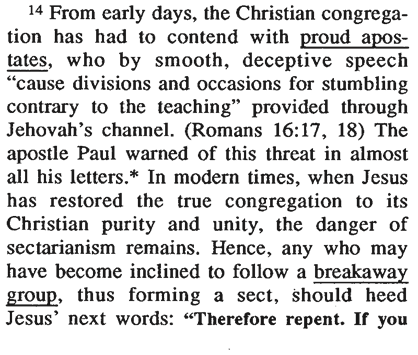
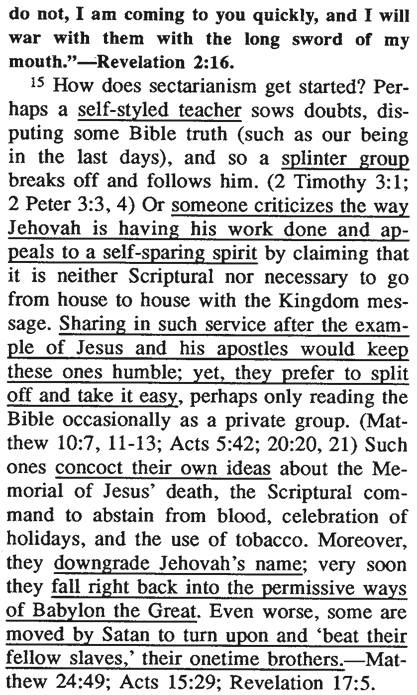
The material addresses none of the
evidence, but focuses its entire effort in making
ad hominen attacks. Any who
disagree with the organizational leadership are “proud apostates.” Their
disagreement with certain Watch Tower interpretations and policy is
labeled a ‘criticism of the way Jehovah is having his work done,’ when
actually the issue is whether there is proof that it is Jehovah who is
causing the organization to act as it does in a number of areas.
13.
What is the issue when they say critics are “disputing Bible
truth that we are in the last days”?
The writer either falsifies or is
ignorant of the true position of those he attacks. He represents them as
‘disputing Bible truth that we are in the last days.’ None of the
persons I know who have withdrawn from the Watch Tower organization
denies our being in the last days. What they do not believe is that
1914 marked the start of the
last days. Thus the writer resorts to the use of half-truths. The writer
never documents by evidence any of his allegations but simply asserts
them, never quotes from the opposing side, leaves his readers totally in
the dark as to what their real reasons are for their positions. Any
conscientious concern for truth is discounted as nonexistent, their
motives are arbitrarily impugned and they are depicted as persons who
appeal to a “self-sparing spirit,” who prefer to “split off and take it
easy,” who “concoct their own ideas about the Memorial of Jesus’ death”
and other subjects, who “downgrade Jehovah’s name,” and who very soon
“fall right back into the permissive way of Babylon the Great,” or “even
worse, some are moved by Satan to turn upon and ‘beat their fellow
slaves,’ their onetime brothers.” Thus the exhortation is given:
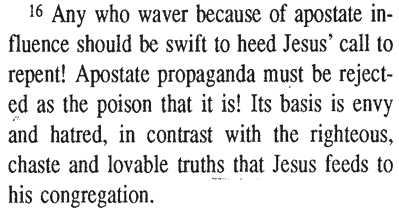
14.
Are the Society’s attacks against those who choose to leave the
Organization new?
Consider now something written almost 90 years ago, back at the
turn of the century. The writer in England describes what a religious
system will do when its credentials are rejected, particularly if the
rejection comes from one very familiar with them or is a person
well-known in the system. He writes:
. . . the
ecclesiastical policy is to conceal a secession, if possible, and, when
it is made public to represent it as dishonest and immoral. My own
position would not for a moment be admitted as bona fide [taken in good
faith]. The gentler of my colleagues seem to think that a “light” has
been taken from me for some inscrutable reason, while others have
circulated various hypotheses in explanation, such as pride of judgment,
the inebriation of premature honours, etc.
. . . secession means
farewell to the past—farewell to whatever honour, whatever esteem and
affection, may have been gained by a life of industry and merit. The
decree . . . goes forth against the “apostate.” He is
excommunicated—cursed in this life and the next—and socially ostracized,
if not slandered. The many, the great crowd of admirers, listen to every
idle tale that is hatched against him; the few, whose moral and humane
instincts are too deep to be thus perverted, can but offer a distant and
stealthy sympathy. He is cast out to recommence life, socially and
financially, in middle age; perhaps he is homeless, friendless and
resourceless. . . . for the credit of the Church and the confusion of
its enemies the seceder must be placed in as unfavourable a light as
possible.
The writer was not one of Jehovah’s
Witnesses, though his words could easily have proceeded from one of
them. The writer in this case, however, was the former Very Reverend
Father Anthony of the Franciscan order (in which he had spent twelve
years).6 But what he wrote in 1903 describes in remarkable
parallel what has been happening to persons within the Watch Tower
movement in recent decades. In reading it I cannot but think of how
perfectly everything said would fit the experience of Edward Dunlap and
others I know in their treatment from the Watch Tower organization. The
trend toward moderation and greater tolerance within the Catholic Church
seems matched by an opposite trend within the Watch Tower organization,
which has consistently (or perhaps one should say, inconsistently)
denounced the authoritarianism of the Catholic hierarchy.
Bending Scripture to Fit
Organizational History
15.
What is an example of the Society’s use of the fallacy of
provincialism?
The fallacy of
provincialism is
particularly evident in the organization’s depicting itself as the
central figure of various Bible prophecies. As but one example, the
Watch Tower publications’ constant reference to events of 1919 and 1922
(the time when the wrongly-based “Millions campaign” and its focus on
1925 was in full swing) shows how—by carefully developing certain
features and incidents while ignoring others—events of a comparatively
trivial nature occurring in a certain period of the past can be
magnified to appear as of monumental significance, of world-shaking
importance.
The book of Revelation (chapters 8 and
9) depicts the blowing of seven trumpets by God’s angels, accompanied by
dramatic destructive effects, and later (chapters 15 and 16) we find a
vision of seven plagues and seven bowls of God’s anger due to be poured
out upon the earth. The striking effects of all these are presented as
of earth-shaking consequence. According to the Watch Tower publications,
these visions have been virtually fulfilled. How? Most notably by seven
resolutions passed at seven conventions of Watch Tower adherents during
the years 1922 to1928.7
Yet today, none of those organizational pronouncements and events
of the 1920s are known by the vast majority of Jehovah’s Witnesses, much
less by anyone in the rest of the world. I seriously doubt that any
member of the Governing Body of Jehovah’s Witnesses would even attempt
to explain in any detail the interpretation of the pouring out of these
bowls and plagues and their supposed individual fulfillments. If
questioned about the fulfillment, they could answer only by reading it
directly from a Watch Tower publication setting out the claimed
interpretation.
6
Twelve Years
in a Monastery,
by Joseph McCabe, O.S.F., Watts & Company.
7
See
Babylon the Great Has Fallen!,
pages 530-575; “Then Is Finished
the Mystery of God,” pages 209-247;
Revelation—Its Grand Climax At
Hand!, pages 129-160.
Prophecies
in the book of Daniel receive similar application. Daniel 8:13, 14
speaks of a “transgression causing desolation” that affects God’s “holy
place” or sanctuary, and goes on to say:
“Until two thousand three hundred
evenings and mornings; and the holy place will certainly be brought into
its right condition.”
16.
How did the JWs apply the fulfillment of Daniel 8:14 & 14 to
themselves?
The book
Your Will Be Done on Earth
(pages 210 to 218) states that this period began on May 25, 1926 and
ended on October 15, 1932. What happened on those dates? The first, in
1926, marked the start of a Watch Tower convention held in London,
England, at which a Resolution was adopted condemning the League of
Nations. Only one newspaper, the London
Daily News, gave any coverage
of the event. The book says (page 213) that the other “London newspapers
hushed up the biggest, most important news of the times.” Thus, the
writer of the book manages to convert this simple lack of interest into
something having an almost conspiratorial air. The ending date, October
15, 1932, is supposedly validated because a
Watch Tower magazine bearing
that date called for the elimination of “elective elders” in all
congregations. (Actually, it resulted not only in ending the
congregational electing of elders, but in the
complete elimination of elder
bodies, these being restored only some 40 years later in the 1970s;
this elimination of elder bodies opened the way for the centralizing of
all administrative authority in the Brooklyn headquarters.)8
The application of Bible prophecy to
events that in many cases are essentially petty truly manifests a vivid
imagination, but not discretion or faithful adherence to Scripture. It
is a clear example of the fallacy of provincialism. The later rejection
of so many of such claimed fulfillments of prophecy demonstrates this to
be so.
8 As has been noted,
Rutherford justified this drastic action by depicting the “elective
elders” as a class of persons who were uncooperative, were weak in, or
were opposing, door-to-door activity, and similar charges. Few persons
stop to think that men like Fred Franz and a host of others very
prominent in the organization were themselves elective elders at that
time. Nor is it ever mentioned that Rutherford himself did not engage in
door-to-door activity.
Rewriting Scripture to Fit
Organizational Claims
17.
How was the JWs view of Jesus’ parable of the “talents” a
demonstration of “circular reasoning?”
As but one example of obvious
circular reasoning, consider
what is done in the book God’s
Kingdom of a Thousand Years Has Approached, scheduled for study a
second time by Jehovah’s
Witnesses some years ago. In it, Jesus’ parable of the “talents” is in
effect
rewritten to accommodate it
to Watch Tower teachings.9 The parable as Jesus gave it may
be summed up as follows:
A man about to travel abroad summons his
slaves and commits to them his belongings, giving five talents to one,
two to another, and one to a third.
The first two use the talents to gain
increase for their master, the third does not.
After a long time the master returns and
settles accounts with them, rewarding the two who gained increase,
casting out the one who did not.
The above-mentioned book, however,
presents what amounts to a
rewritten script of this parable, one that adds features to it to
make it fit the organization’s teachings and history. This is the way
Jesus’ parable would read according to the Watch Tower’s publication,
with the altered points shown in italics:
A man about to travel abroad, summons
his slaves and commits to them his belongings, giving five talents to
one, two to another, and one to a third.
The first two use the talents to gain
increase for their master, the third does not.
After a long time the master returns.
He is going to settle accounts
with his slaves, but before he can do so an enemy comes in and attacks
them. The enemy strips those who had made gain, takes their money, and
carries all of them into captivity. When they return from captivity,
they tell their master that all the increase they had gained was taken
away from them. He replies that he understands and that he will give
them an extension of time during which they can gain some increase.
If it seems hard to believe that an
organization would actually “adjust” Scripture to that extent to fit its
organizational interpretation, consider these statements as they appear
directly in the book referred to, pages 231, 232. It first describes the
Witnesses’ supposed “captivity” period of 1918-1919. The book alters the
description to make it sound more like a vicious “mugging” attack than a
carrying of captives off to be bond servants. Without explaining why
this different version is offered, the book then proceeds to the spring
of 1919 (the time of the “release” from Babylon in other Watch Tower
publications) and says:
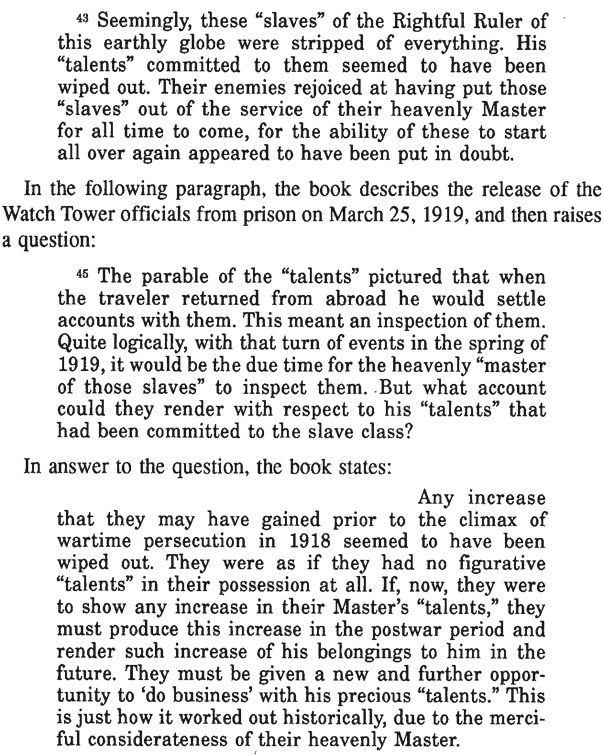
9 See
Matthew 25:14-30.
Note the way in which it is said that
“seemingly” the master’s slaves were stripped, their talents “seemed” to
have been wiped out, that they were “as if” they had no talents to show
their master. Either they had
been stripped of them or they had not, which was it? Christ Jesus, after
all, is described in prophecy as a judge who “will not judge by any mere
appearance to his eyes,” but who goes by the reality of matters, not by
what “seems” to be the case.10 So, if indeed, the slaves, in
order to show any increase, “must
produce this increase in the postwar period” and “must
be given a new and further opportunity”—as the book tells us they
must—it could only mean that the enemy did indeed strip their increase
from them, not just “seemingly” so. The further opportunity is so that
they can render increase to their master “in the
future,” which means that
they render it after the
inspection begins, not at the
time of the inspection as stated in the parable.
10
Isaiah 11:2,3.
Again, the book does not clarify the
basis for this strange explanation of the parable’s fulfillment, this
obvious embroidering of the account of what happened at the master’s
return, or the reasoning to support such a remarkably rewritten
presentation of matters. It simply says that this is the way it was, the
way it “must” be. It is not the way Jesus presented it, but that seems
not to matter.
18.
Why do JWs change the meaning of some Scriptures?
In reality, what the book does is make
the scriptures conform to certain features of the organization’s
history, as if that history was dominant and determinative over
scripture. Thus, the release from prison of the Watch Tower officials in
the spring of 1919 is depicted as a sort of signal to Christ Jesus,
letting him know that “logically” this would be “the due time” for him
to begin his inspection (although according to the organization’s
teaching his “invisible return” had already been in effect for over four
years, since 1914).
The Biblical parable of the talents
itself says nothing of the two faithful slaves having lost (or being
robbed of) the gain they had made, nor of the master’s giving any “new
and further opportunity” to any of his slaves. But the organization’s
explanation of its history requires that. It is necessary if the
organization is going to harmonize its teachings and interpretations on
other points. So it is said that this “must” have been the case, since
this is “just how it worked out historically.” This is a graphic example
of the use of “circular reasoning.”
The organization thus can not only
determine how the scripture is to be applied (this being determined by
its own experiences), but they are also capable of elaborating on the
scripture, embroidering the account. When coming to realize that this
was actually what was being done, not merely in this case but in others,
I could not find it in myself to believe that God ever purposed that any
man or group of men should have the right to handle his Word in such an
arbitrary fashion, in effect to play with it as with a personal toy.
19.
What conflict arises between the interpretation of the “talents”
and the “faithful and discrete slave?”
Likewise, I can find no justification
for the way the organizational history is colored to suit any particular
explanation being given at the moment. When claiming a prophetic
parallel between the organization’s 1918-19 situation and Israel’s
Babylonian captivity, its members are depicted as “unclean,” “guilty of
transgression,” “selling themselves because of wrong practices.” When
shifting over to describe the same ones in relation to the parable of
the “faithful and discreet slave,” a very different picture is painted,
as seen in the Watchtower of
July 15, 1960 (page 436):
20. What history did the 40-year-old
organization have to qualify it for being chosen of God as His
representatives?
Despite all this glowing prose, the fact
is that in 1919 this was an approximately 40-year-old organization, one
that was not old but quite new. It was an organization that could show
no relationship linking it with anything other than Second Adventism
during the preceding nineteen centuries, one that had made numerous
erroneous time predictions which were quietly wiped out of later
editions of the publications, and one that, childlike, would keep on
making more of the very same kind of mistakes, while leveling criticism
at those who had the discernment to realize that these were indeed
mistakes. Moreover, the organization’s own publications present it as an
organization fresh out of Babylonian captivity in 1919, a captivity
resulting from its own transgressions and uncleanness. Yet it is here
presented as the culmination, the epitome of a mature, tested and
trustworthy, 1900-year-old faithful and discreet slave! This is clearly
playing fast and loose with the facts. All the impressive qualities and
age it attributes to itself have as their only basis its own
claims about itself—a classic
example of circular reasoning.
21.
What standards are used to determine divine approval and
God-given assignments of authority?
Circular reasoning is also seen in that,
in any discussion of qualifying for divine approval and assignment of
authority the organization itself chooses the standards and conditions
for passing the test, standards and conditions that are all adapted to
fit precisely whatever it had been doing at the time that might be
considered distinctive. The result of the “test” at the time of Christ’s
supposed invisible return is thus totally geared in their favor, so that
they cannot fail to appear as victors. When posing the question whether
Christ as Master had, upon his claimed return, found them doing as he
wished, the Society’s book God’s
Kingdom of a Thousand Years Has Approached (page 351) says:
He must have found them so,
according to the way the inspection, begun in 1919, has affected his
decisions since.
What have been ‘Christ’s decisions’
since 1919? Who is so privy to his dealings or so “in the know” as to
what he has been deciding in the invisible spirit realm since that year
to tell us? By what could only be divine revelation, the Watch Tower
organization presumes to supply this information and let its readers
know that his decisions have been such as to identify it itself
positively as his approved channel.
22.
What noteworthy message was made as “a notification to all the
world” at the 1919 Cedar Point, Ohio, convention?
Thus the book unabashedly assures its
readers that:
. . . the eight-day general convention
held at Cedar Point, Ohio, on September 1-8, 1919, was a notification
to all the world [indicating] who it was that the returned Lord
Jesus had found to be his ‘faithful and discreet slave’ class.11
Along with provincialism, all of this is
an obvious form of circular reasoning which, in effect says, “we must
have passed the test successfully and been chosen since our
interpretations of Scripture, and the applications we make of these to
ourselves, show that we must have passed the test successfully and were
chosen.” It is a case of supporting a claim by using that same claim as
the foundation for the support, validating its revelation with its
revelation.
11 God’s Kingdom of a Thousand
Years Has Approached,
page 353.
23.
What “Overwhelming Credentials” did the Society cite in its March
1, 1981 Watchtower the proved that the “anointed class” was the
“faithful and discrete slave?”
Consider but one more of the notable
examples of combined circular reasoning and provincialism. The March 1,
1981, Watchtower (page 27)
contained an article on the “faithful and discreet slave” in support of
the organization’s interpretation of the parable and its application to
the “anointed class” among Jehovah’s Witnesses. At the conclusion of the
article, this material followed:
 12
12
24.
Upon what factor does the “overwhelming” evidence depend?
The truly “overwhelming” factor is that
every single item in this list of “credentials” depends entirely on the
Watch Tower organization’s unique interpretation to make it a
“credential.” This is circular reasoning comparable to a man’s saying,
“I am the greatest person in all human history and I have the
credentials to prove it. Just look at this long list of famous men and
women of the past, and then read these writings of mine in which I have
applied everything said about them to myself.”
What normal person on reading, for
example, the Biblical account in which the first person on this long
list (“Noah’s wife”) appears would ever say, “Yes, that certainly is a
credential identifying the anointed Witnesses of Jehovah since 1919 as
the ‘faithful and discreet slave’”—or, for that matter, any single one
among the other 79 listings of persons (such as “angels sent to Lot,”
“Joseph and Benjamin,” “two spies sent to Rahab,” “intimate group,”
“Shearjashub,” etc.) and things (such as “gleanings left behind,” “light
of the nations,” “cluster preserved,” etc.)? It is actually
cynical—demeaning to persons’ intelligence—to ask them to accept such
arbitrary listings as “overwhelming credentials” for anything.
And it is a measure of the degree of indoctrination achieved
among its members that an organization can even publish such material as
“credentials” without feeling deep personal embarrassment.
11
Note that
the preparer of this list of “overwhelming credentials” follows the
order of Bible books from Genesis to Revelation but then, at the very
end, goes back to Isaiah 43:10 so as to put “Jehovah’s Witnesses” there,
thus giving the illusion that all the preceding listings were leading up
to that culmination. This is pure manipulation.